September Meeting Notes
Attendees: 5
Dinner with King Tut: How Rogue Archaeologists Are Re-Creating the Sights, Sounds, Smells, and Tastes of Lost Civilizations By Sam Kean
Meeting:September 30, 2026
Format:Virtual Zoom Meeting
Attendance:5 attendees
Special Guest: Dr. Serena Love, Archaeologist & Egyptologist
About the Meeting
September’s meeting took us far beyond the traditional way of studying history. Together, we explored Dinner with King Tut, a fascinating blend of archaeology, science, storytelling, and historical reconstruction.
The book introduces experimental archaeology—the practice of recreating ancient tools, foods, techniques, and experiences to better understand how people actually lived.
Rather than looking at history only through artifacts and written records, Sam Kean asks us to imagine the past through all five senses: sight, sound, smell, taste, and touch.
Discussion Notes
History Is More Than What We See
One of the biggest ideas we explored was how much of history is lost when we only study what survives. Artifacts can tell us what people built, used, or left behind, but they don’t always tell us what everyday life felt like.
The book made us think about questions such as:
- What did ancient food actually taste like?
- What did people’s homes and cities smell like?
- What did ancient tools feel like in someone’s hands?
- How loud were ancient cities?
- What did ordinary people do during a normal day?
- How much can modern experiments teach us about people who lived thousands of years ago?
Kean’s approach makes history feel much more human and immersive.
The Fictional Stories
Another major discussion point was the book’s unusual combination of nonfiction and fictional storytelling. Each chapter includes a fictionalized “day in the life” of people living in different historical periods. These characters are invented, but their surroundings and circumstances are informed by archaeological evidence. This created an interesting question for the group:
Does historical fiction help us understand the past—or can it blur the line between what we know and what we imagine?
The fictional sections gave emotional context to the archaeological information and allowed us to picture ancient people as individuals rather than simply as names, artifacts, or civilizations.
History Across the World
One thing that stood out about the book was its enormous geographic and historical range.
The chapters move through:
- Africa — 75,000 years ago
- South America — 7500 BC
- Turkey — 6500s BC
- Egypt — 2000s BC
- Polynesia — 1000s BC
- Rome — AD 100s
- California — AD 500s
- Viking Europe — AD 900s
- Northern Alaska — AD 1000s
- China — AD 1200s
- Mexico — AD 1500s
This gave the group an opportunity to compare how dramatically human life differed across time and geography while also recognizing how many human experiences remain familiar.
Takeaways From the Discussion
History can be experienced, not just memorized.
The book challenged the traditional idea that studying history means simply reading dates, examining artifacts, and learning about famous people.
Experimental archaeology shows that researchers can sometimes learn by doing—making tools, preparing ancient foods, testing weapons, recreating techniques, and attempting to experience historical environments themselves.
Questions We Left With
- How much of ancient history can we actually reconstruct?
- Where should historians draw the line between evidence and imagination?
- Can recreating an ancient activity tell us something that an artifact cannot?
- Which historical periods would we want to experience firsthand?
- What everyday aspects of our own lives might disappear from the historical record?
Special Guest Conversation
We were also joined by Dr. Serena Love, archaeologist and Egyptologist, for a relaxed conversation about archaeology, ancient history, and the process of reconstructing the past. Her perspective helped connect the ideas in the book to the real-world work of archaeologists and gave us an opportunity to think about ancient history beyond what we encounter in books and museums.
September’s Big Idea
The past wasn’t just something people saw—it was something they tasted, smelled, heard, touched, built, ate, and experienced.
Dinner with King Tut encouraged us to look at history differently: not simply as a collection of events that happened long ago, but as the lived experiences of real people. That made this month’s discussion especially fitting for The Tea Is Historical—because history becomes even more interesting when we can imagine ourselves sitting across the table from the people who lived it.
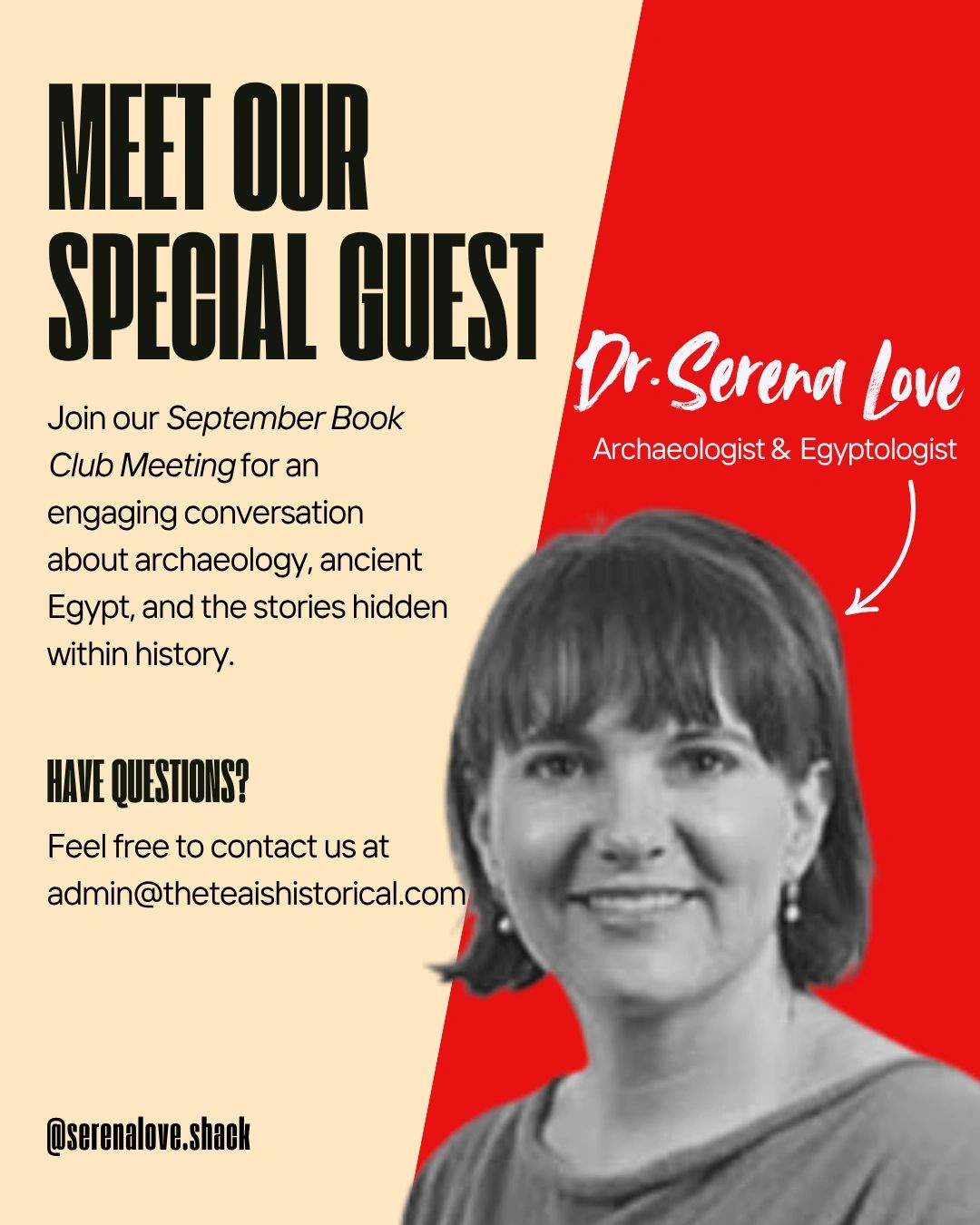
We are excited to welcome Dr. Serena Love as a special guest at an upcoming meeting of The Tea Is Historical! Dr. Love is an anthropological archaeologist whose work explores the relationship between people, architecture, landscapes, and the material world. She holds a PhD in Anthropology from Stanford University, an MPhil in Egyptian Archaeology from University College London, and an MSc in Environmental Archaeology from the University of Sheffield. Her academic career has included teaching and research at institutions including Stanford University, Brown University, and the University of Queensland, where she has taught courses in archaeology, Egyptian archaeology, cultural anthropology, and environmental archaeology.
Her research has included ancient Egypt, Egyptian architecture and landscapes, geoarchaeology, prehistoric architecture, and the archaeology of ancient cultures. She has also conducted research in places including Egypt, Turkey, and the broader ancient world Near East, bringing a fascinating perspective to the study of the past. During our upcoming book club meeting, members will have the opportunity to hear directly from Dr. Love, learn more about her work, explore archaeology beyond the pages of our book, and ask questions about her experiences as an archaeologist and scholar.
Whether you are a longtime history lover or simply curious about the people and stories behind the archaeological record, this is a conversation you won’t want to miss.
Discover History
We deliver exceptional results in everything we do, ensuring your satisfaction at every step.
Build Community
Our experienced team brings skill and passion to every project, no matter the size.
Shape the Future
Proven outcomes that speak for themselves and make a meaningful difference for your business.